

From Deterministic Grammar to Probabilistic Language: A Quantum-Inspired Perspective for English Teachers

Updated: Feb 6
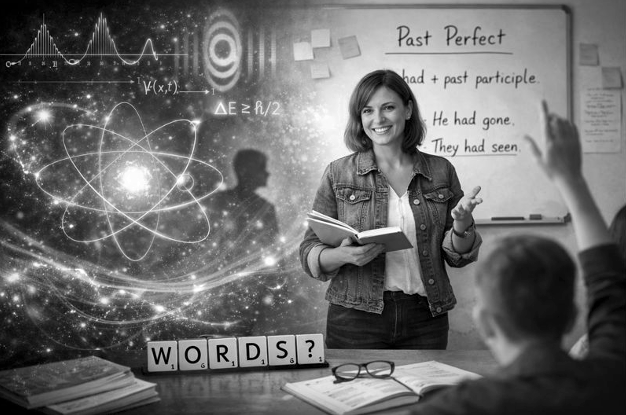
In the world of education, we often search for the perfect method — the one that guarantees results, the one that can be applied to any class, any context, any student. This desire is understandable. Teachers want clarity, stability, and evidence. They want learning to be something that can be explained and predicted.
But what if learning a language is not fully predictable?
What if language development is not a straight line, but rather a system of probabilities, fluctuations, emerging patterns and temporary instability?
This is where a fascinating parallel becomes possible — not as a scientific comparison, but as an intellectual lens: the difference between deterministic thinking and probabilistic thinking, a shift that has shaped modern science since the birth of Quantum Physics. And perhaps, the same shift is needed in ELT.
Deterministic teaching: the “classical physics” model of language
For decades, language teaching was influenced (directly or indirectly) by a very “classical” mindset:
There is a correct system.
Learners must internalise it step by step.
Input → Practice → Mastery.
If a student makes errors, something must be missing.
If we correct and repeat enough, the system will stabilise.
In short: language is treated as a structure that can be mastered through control.
This deterministic approach is still present in many classrooms:
grammar syllabi organised from simple to complex,
tests based on accuracy,
correction as the primary form of feedback,
the belief that progress should be visible at each stage.
And yet, every teacher knows the uncomfortable truth:
Students do not learn like that.
The ELT paradox: students improve… but not consistently
How many times have we seen the following?
A learner uses a structure correctly in class, then “forgets” it the next week.
Fluency improves but accuracy decreases.
A student who performs poorly in tests speaks confidently in real-life communication.
Learners show sudden progress after long periods of stagnation.
Students understand everything, but cannot produce language under pressure.
These are not exceptions. They are the normal behaviour of language acquisition.
This is where deterministic thinking begins to fail — because it expects learning to be stable and linear.
But language learning behaves less like a machine, and more like a living system.
A probabilistic view of language development
Quantum Physics introduced an uncomfortable but powerful idea: at a fundamental level, reality is not always deterministic.
Instead of asking:
“Where exactly is the particle?”
Quantum physics asks:
“What is the probability of finding the particle here or there?”
In other words, it replaces certainty with likelihood.
Now, if we bring this mindset into ELT, we stop asking:
“Has the student learned the past perfect?”
and we begin asking:
“How likely is the student to use this structure successfully in communication?”
This shift changes everything, because it acknowledges the following:
Language competence is not binary (learned / not learned).
Language competence is distributed and context-dependent.
Performance is influenced by emotional, cognitive, and situational factors.
Language emerges through use — not only through explanation.
The myth of full control (and why it frustrates teachers)
One of the greatest causes of teacher frustration is the illusion of control.
When we work in a deterministic mindset, we unconsciously create expectations like:
“If I teach it well, they will learn it.”
“If they repeat it, they will remember it.”
“If they understand it, they will use it.”
“If I correct it, they will avoid the error.”
But language learning is not like assembling a structure brick by brick.
It is closer to a complex adaptive system:
multiple variables interact simultaneously,
learners reorganise their interlanguage constantly,
progress happens through internal re-patterning,
errors are signs of development, not malfunction.
The teacher is not an engineer building a product.The teacher is a guide shaping conditions where learning can emerge.
A quantum-inspired metaphor: competence exists in “states”
In quantum theory, systems exist in “states” until a measurement occurs.
In ELT, learners also shift between states — and we can observe them daily:
state of confidence vs anxiety
state of fluency vs hesitation
state of experimentation vs avoidance
state of risk-taking vs silence
The same learner can appear “advanced” one day and “weak” the next, not because they are inconsistent, but because competence is dynamic and sensitive to context.
This is not a failure of the learner.It is a misunderstanding of learning.
Why errors are not evidence of ignorance
In deterministic teaching culture, errors are treated as defects to eliminate.
In probabilistic language learning, errors are expected phenomena:
signals of experimentation,
traces of restructuring,
temporary imbalances during development.
Correctness becomes less important than:
availability of resources in the learner’s system,
willingness to take risks,
communicative success,
frequency and recency of activation,
quality of meaningful exposure.
A student who makes errors is not “wrong”.They are building probability.
From rules to patterns: the real shift in modern ELT
When we accept a probabilistic view, our core mission changes.
Instead of trying to transmit rules, we try to build:
patterns
habits
usage frequency
retrieval paths
communicative readiness
This aligns perfectly with what research suggests:
Language becomes automatic through:
exposure,
meaningful interaction,
repeated retrieval,
emotional relevance,
authentic communicative pressure.
Not through explanation alone.
Implications for classroom practice
A quantum-inspired, probabilistic mindset does not mean abandoning grammar.It means repositioning it.
1) Teach grammar as support, not as the centre
Grammar becomes a tool for clarity, not the definition of proficiency.
2) Reduce obsession with perfection
Fluency and meaningful interaction must have protected space in the lesson.
3) Accept instability as growth
A “messy” interlanguage is not regression.It is development happening in real time.
4) Focus on recurrence
What matters is not whether the learner used it correctly once.What matters is frequency over time.
5) Move from evaluation to observation
Teachers should observe patterns, not isolated performances.
Conclusion: toward a more realistic model of learning
Perhaps the most powerful lesson we can take from modern scientific thinking is not scientific at all — it is philosophical:
Some systems cannot be fully controlled, only guided.
Language learning is one of those systems.
And when English teachers move from deterministic expectations toward probabilistic understanding, something liberating happens:
We stop blaming students for natural learning behaviour.
We stop blaming ourselves for not producing linear progress.
We start designing classrooms that respect complexity.
We become more patient, more strategic, and more effective.
In the end, the goal is not to create perfect language machines.
The goal is to increase the probability that learners will communicate successfully —with confidence, adaptability, and a growing voice in English.
EdYOUFest Control Tower Team


Comments