

Walking Hadrian's Wall: Lessons on Borders, Learning and Humanity


There are many reasons to walk.
Some people walk to stay fit. Others walk to escape the noise of everyday life. Some walk simply because the journey itself offers a different way of seeing the world.
But occasionally, a walk becomes something more. It becomes an opportunity to reflect—not only on history, but also on us.
That is what Hadrian's Wall offers.
Stretching across the north of England for over 70 miles, Hadrian's Wall has stood for almost two thousand years (those bits that are not now neighbouring houses!). It remains one of the starkest reminders of the Roman Empire and an iconic historical landscape feature. Millions visit it each year to admire its engineering, its beauty and its extraordinary survival through the centuries.
Yet the Wall is much more than an archaeological monument.
It is a question.
Why do human beings build walls?

Historians still debate the original purpose of Hadrian's Wall. Was it designed to defend the Roman frontier? To regulate trade and movement? To demonstrate the power of an empire? Or perhaps to provide work for thousands of soldiers stationed far from home, keeping them too busy to rebel?
The truth is that we cannot answer with complete certainty.
What we do know is that the Wall represented a division between worlds—a physical line intended to separate "us" from "them."
Nearly two thousand years later, the stones remain, but the people do not.
The Romans have gone, or blended with locals to become Britons. The tribes they feared have disappeared into history. The empire itself exists only in books, museums and memories. Yet people now walk freely across what was once one of Europe's most heavily guarded frontiers.
History has quietly reminded us of something profound.
Walls divide. And often remain. Physical and mental markers of a division.
People tend to follow a wall, or see those on the other side as….other.
As educators, this thought deserves our attention.

Education has, by its very nature, always existed in opposition to division. While societies often create barriers—between nations, languages, cultures or beliefs—education has consistently sought to remove them. Every language learned, every book translated, every international friendship formed and every classroom discussion across cultures becomes an act of bridge-building. Unless of course we turn to the DARK Side of education: indoctrination…
Perhaps that is why places like Hadrian's Wall feel so relevant today.
We live in an age where new walls continue to appear.
Some are physical.
Many are invisible.
Political differences, social inequalities, basic equal rights misinformation, prejudice, fear of change and digital echo chambers all create walls between people. Sometimes those boundaries appear inside schools themselves—in the assumptions we make about students, the opportunities they receive or the confidence they believe they possess.
Teachers encounter these invisible walls every day.
A learner convinced they are "not good at languages."
A teenager who believes university is beyond their reach.
A classroom where cultural differences create hesitation instead of curiosity.
These walls cannot be demolished with machinery.
They are dismantled conversation by conversation, lesson by lesson and relationship by relationship.
This is why language education matters so deeply.
Learning another language is not simply acquiring vocabulary or mastering grammar.
It is an invitation to see the world through another person's eyes.
Every new language reminds us that there is never only one way to express an idea, solve a problem or understand another human being.
Every international exchange demonstrates that our similarities usually outweigh our differences.
Every educational journey expands not only knowledge but perspective.
Perhaps this is why international teacher communities have become increasingly important.
When educators from different countries share ideas, experiences and challenges, they do far more than exchange classroom techniques. They create understanding between cultures. They remind one another that although educational systems may differ, the aspirations for young people remain remarkably similar.
Every EdYOUFest event reflects this philosophy.
Teachers travel from different countries, bringing different experiences, methodologies and traditions. Yet after only a few conversations, those differences become strengths rather than obstacles.
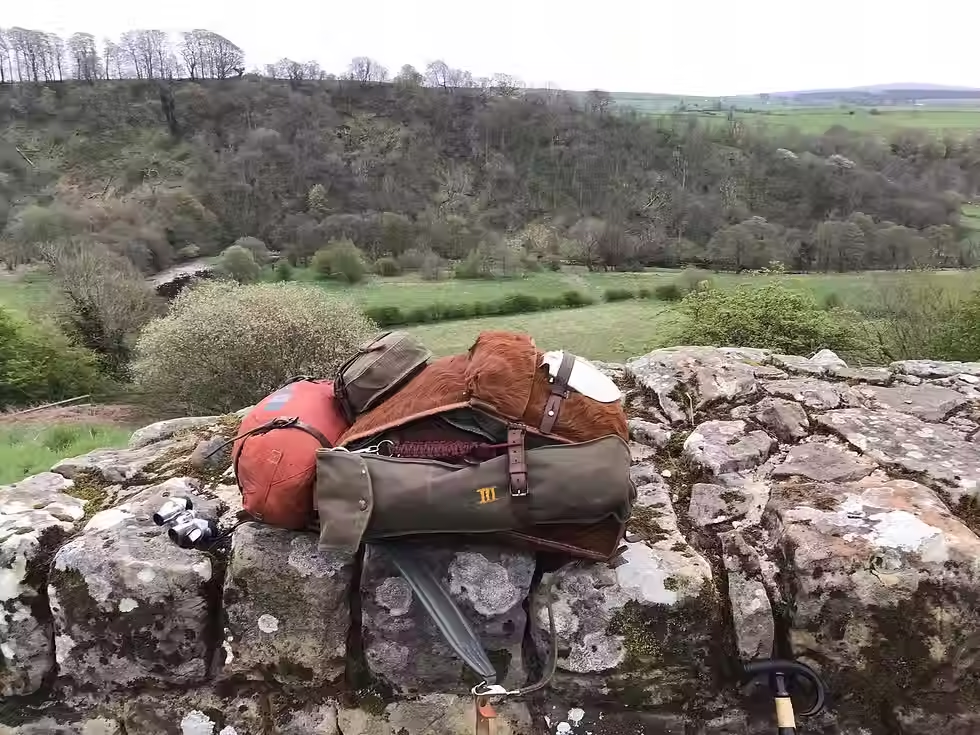
The conversations become richer because of diversity, not despite it.
Walking Hadrian's Wall offers the same lesson.
Standing upon stones laid almost twenty centuries ago, it is impossible not to wonder what the builders imagined the future would look like.
Could they ever have imagined visitors from every corner of the world walking peacefully across what they built as a barrier?
Could they have imagined people speaking dozens of languages, from all over the world, whilst admiring the same landscape?
Could they have imagined that the Wall itself would become a symbol not of division, but of shared heritage?
Perhaps history possesses a quiet sense of humour.
The very structure designed to separate people now brings them together.
That transformation carries an important message for educators.
The world our students inherit will undoubtedly contain challenges we cannot yet predict.
Technology will continue to evolve.
Artificial intelligence will reshape professions and even the core of human interaction.
Global migration will continue to influence societies.
New political and environmental realities will emerge.
The facts we teach today may change tomorrow.
The ability to connect with others, however, will always remain essential.
Curiosity.
Empathy.
Communication.
Critical thinking.
Collaboration.
These are the skills that allow people to cross borders far more successfully than passports ever could.
Perhaps our greatest responsibility as educators is not simply to prepare students for examinations or careers, but to prepare them to meet people unlike themselves with openness rather than suspicion.
To replace certainty with curiosity.
To replace fear with understanding.
To replace walls with bridges.
Walking Hadrian's Wall reminds us that every generation leaves something behind.
Some leave monuments.
Some leave institutions.
Some leave discoveries.
Teachers leave people.
Every learner whose confidence grows.
Every student who discovers another culture.
Every young person inspired to travel, to question, to listen or to dream.
These are the lasting legacies of education.
Long after today's debates have faded, long after today's borders have shifted, long after new technologies have replaced old ones, those human connections will remain.
Perhaps that is the greatest lesson Hadrian's Wall has to offer.
History may remember the walls we built.
Humanity will remember the bridges we created.
By Thom Jones


Comments