

3 Things, 2 Mirrors & 1 Window

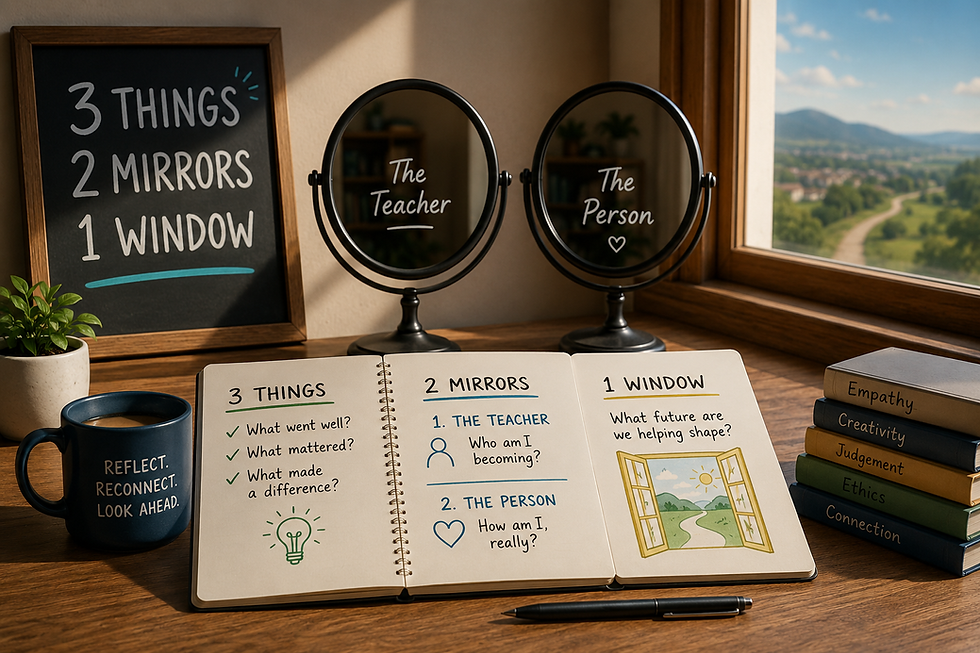
Last Wednesday at 1.55 pm I was perched at the back of the room, my mentor's observation notepad balanced on my knee while the classroom was turning into something that looked like a busy airport terminal packed with passengers eager to board their flight. Over the last few weeks I had been officially assigned to look after Martina, our latest trainee teacher, tasked with sitting in on her lessons, observing her progress, and delivering that always-dreaded post-class feedback. On paper, her lesson had been beautifully modern, packed with tech-savvy elements—interactive whiteboard games, digital quizzes, and QR codes galore.
They were brilliant tools for keeping the energy high, but as I wove through the clutter of chairs to reach her behind my desk, I realised that all those flashing digital metrics couldn't help her assess the real emotional and cognitive shifts happening in the room. There she sat, clutching a colour-coded lesson plan like a flotation device, her eyes wide with panic, utterly clueless as to how to gauge her own pedagogical impact.
I couldn’t help but wonder: in a profession increasingly obsessed with automated data and rigid rubrics, have we forgotten how to cultivate human intuition? How can a newly-qualified teacher measure the magic when the most critical metrics can't be computed by an app, let alone captured by twenty distracted teens ready to bolt for the school gates?
I glanced at her flashing interactive whiteboard, then back to her wide, panicked eyes, and decided it was high time to introduce her to a bit of old-school humanistic magic: the 'two mirrors and a window' theory.
I told her that while tech tracks what the pupils do, the concept of the human touch explores who they are while doing it. To truly elevate her practice and make her lessons unforgettable, she just needed to layer it with three beautifully simple, human dimensions.
The Linguistic Mirror (One thing about the language): This first reflection tracks the mechanical structures of grammar and vocabulary, showing the mind how it actively processes a new foreign code.
The Psychological Mirror (One thing about yourself): This is where the humanistic emphasis on self-esteem and identity lives. This reflection forces an inward gaze, using the teenager's own memories and burgeoning emotional intelligence to explore who they are when stripped of their native eloquence.
The Intercultural Window (One thing about the world) : This opens the classroom's view outward. By sharing these personal insights, the room transforms into a cooperative micro-society where collaborative dialogue builds genuine empathy for alternative worldviews.
Blending these three dimensions with her tech-savvy approach gave Martina a way to reflect on her teaching efficacy and she realised that meaningful evaluation means using those tools to open a door, and using her human touch to open a window.
Not only Martina did survive her first day, but she also found the secret to balancing the digital age with the human heart, which leaves us with the ultimate operational challenge: how can you organise your lesson in order to seamlessly integrate these three dimensions into your daily teaching practice?
Rinvolucri, M. (1984). Grammar Games: Cognitive, Affective and Drama Activities for EFL Students. Cambridge University Press.
Moskowitz, G. (1978). Caring and Sharing in the Foreign Language Class: A Sourcebook on Humanistic Techniques. Newbury House Publishers.
Arnold, J. (Ed.). (1999). Affect in Language Learning. Cambridge University Press.

Larissa Albano


Comments